

Reducing alert fatigue through informatics in nursing in the Emergency Department
Jasmine Morrow RN
Welcome to my Nursing Informatics e-Portfolio. This project examines alert fatigue in the emergency department (ED), one of the most significant informatics challenges affecting nurses and patient safety today. Clinical Decision Support Systems (CDSS) integrated within Electronic Health Records (EHRs) are designed to provide timely alerts that help healthcare providers prevent medication errors, identify allergies, recognize abnormal laboratory values, and support evidence-based clinical decisions. However, when clinicians are exposed to an excessive number of alerts—many of which are repetitive or clinically insignificant—they may become desensitized to these notifications. This phenomenon, known as alert fatigue, can increase the likelihood of important alerts being overlooked, contribute to workflow interruptions, and negatively impact patient outcomes.
As an emergency department nurse, I have witnessed how constant electronic alerts can interrupt critical thinking and patient care in a fast-paced, high-acuity environment. This project explores the causes and consequences of alert fatigue while demonstrating how nursing informatics can improve the design and effectiveness of clinical decision support systems. By optimizing alerts and incorporating evidence-based informatics strategies, healthcare organizations can reduce unnecessary interruptions, improve clinical decision-making, and enhance patient safety.
This e-portfolio aims to:
- Explain the causes and impact of alert fatigue in emergency nursing practice.
- Analyze current emergency department workflows and technologies that contribute to excessive clinical alerts.
- Evaluate how alert fatigue affects nursing efficiency, patient safety, and clinical decision-making.
- Present evidence-based recommendations to improve clinical decision support systems and reduce unnecessary alerts.
- Demonstrate how nursing informatics principles support safer, more efficient, and patient-centered care.
Mission Statement
The mission of this e-portfolio is to promote awareness of alert fatigue as a critical nursing informatics issue and to advocate for technology solutions that support, rather than hinder, clinical decision-making. By leveraging evidence-based informatics practices, emergency departments can create safer electronic health record systems, improve nursing workflow, reduce cognitive burden, and ultimately provide higher-quality patient care.
Issue Analysis
Background:
Clinical Decision Support Systems (CDSS) are integrated into Electronic Health Records (EHRs) to assist healthcare providers in making safe, evidence-based clinical decisions. These systems generate electronic alerts that notify clinicians of potential medication allergies, drug-drug interactions, duplicate therapies, abnormal laboratory values, and other patient safety concerns. While these alerts are intended to reduce medical errors and improve patient outcomes, the increasing number of notifications has created an unintended consequence known as alert fatigue.
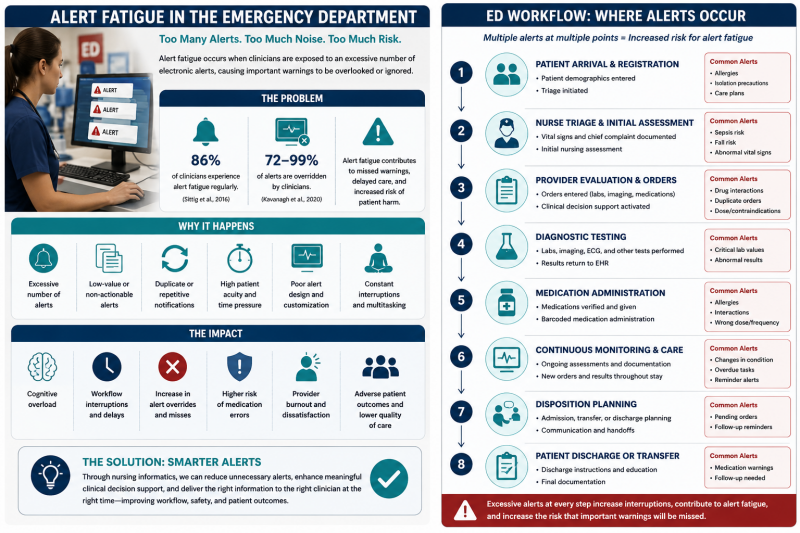
Alert fatigue occurs when clinicians become overwhelmed by the volume of electronic alerts, many of which are repetitive, low-priority, or clinically insignificant. As providers are exposed to excessive notifications throughout their shift, they may become desensitized and begin overriding or ignoring alerts without fully reviewing them. In the emergency department (ED), where nurses and providers work in a fast-paced, high-acuity environment, alert fatigue poses a significant patient safety concern. Frequent interruptions can disrupt clinical workflow, increase cognitive workload, delay critical interventions, and contribute to medication errors or missed warnings.
Nursing informatics plays a vital role in addressing alert fatigue by evaluating how clinical decision support systems are designed and used within healthcare organizations. Informatics specialists collaborate with frontline nurses, providers, pharmacists, and information technology professionals to optimize alert systems so that clinicians receive timely, relevant, and actionable information without unnecessary interruptions.
Scope of the Issue
Alert fatigue affects healthcare organizations worldwide and is recognized as a major challenge in nursing informatics and patient safety. Emergency departments are particularly vulnerable because clinicians manage multiple patients with varying levels of acuity while continuously responding to electronic documentation requirements, medication administration, laboratory results, diagnostic testing, and provider communication.
Common factors contributing to alert fatigue include:
- Excessive numbers of medication and clinical decision support alerts
- Duplicate or repetitive notifications
- Low-priority alerts with limited clinical significance
- Poorly designed EHR interfaces
- High patient volumes and time-sensitive decision-making
- Frequent workflow interruptions and multitasking
The consequences of alert fatigue extend beyond clinician frustration. Excessive alerts may lead to important warnings being overlooked, delayed clinical decisions, increased documentation burden, reduced workflow efficiency, provider burnout, and preventable patient safety events. Because emergency nurses rely heavily on electronic health records to coordinate care, optimizing alert systems is essential for improving both patient outcomes and clinician performance.
Stakeholders
Successfully reducing alert fatigue requires collaboration among multiple healthcare professionals and organizational leaders.

Emergency Department Nurses
Emergency nurses interact with clinical decision support alerts throughout every shift. They are responsible for assessing patients, administering medications, documenting care, and responding to electronic alerts while managing multiple competing priorities. Their feedback is essential for improving the usability and effectiveness of alert systems.

Emergency Physicians and Advanced Practice Providers
Providers depend on accurate clinical decision support to guide diagnostic testing, medication prescribing, and treatment decisions. Optimized alerts help improve patient safety while minimizing unnecessary workflow interruptions.

Pharmacists
Pharmacists play an important role in evaluating medication-related alerts, identifying clinically significant drug interactions, and collaborating with informatics teams to improve medication safety within the EHR.

Hospital Leadership and Quality Improvement Teams
Healthcare administrators and quality improvement leaders monitor patient safety indicators, medication error rates, regulatory compliance, and clinician satisfaction. They support initiatives that balance patient safety with efficient clinical workflows.

Evidence Based Recommendations
Reducing alert fatigue requires a multidisciplinary approach that combines nursing expertise, health information technology, evidence-based practice, and continuous quality improvement. The following recommendations are supported by current nursing informatics literature and are designed to improve clinical decision support (CDS), enhance workflow efficiency, and promote patient safety within the emergency department.
View recommendations below.
Optimize Clinical Decision Support Alerts
Clinical decision support systems should be redesigned to prioritize high-severity alerts while reducing low-value or repetitive notifications. Alerts related to life-threatening allergies, severe drug interactions, critical laboratory values, and contraindications should receive the highest priority, whereas informational or low-risk alerts should be minimized or displayed in a less disruptive manner.
Supporting Evidence: Research has shown that excessive low-priority alerts contribute significantly to alert fatigue and increase alert override rates. Prioritizing clinically meaningful alerts improves provider response and supports safer clinical decision-making.
Expected Outcomes:
- Fewer unnecessary interruptions
- Reduced alert override rates
- Improved recognition of high-priority patient safety alerts
- Enhanced medication safety
Customize Alerts for the Emergency Department
Alert systems should be tailored to the unique workflow of the emergency department rather than using standardized alerts across all hospital units. Emergency nurses and providers care for patients with rapidly changing conditions, requiring alert systems that are relevant to high-acuity, time-sensitive care.
Examples include:
- Sepsis screening alerts
- Stroke protocol reminders
- Trauma activation notifications
- Critical laboratory value alerts
- High-risk medication warnings
Supporting Evidence: Department-specific clinical decision support improves workflow efficiency by delivering relevant information while decreasing unnecessary notifications that do not apply to emergency care.
Expected Outcomes:
- Improved workflow efficiency
- Faster clinical decision-making
- Greater clinician satisfaction
- Reduced cognitive workload
Involve Frontline Nurses in Alert Design
Emergency department nurses should actively participate in the design, testing, and evaluation of clinical decision support systems. Because nurses interact with electronic alerts throughout every shift, they are uniquely positioned to identify alerts that are unnecessary, repetitive, or difficult to interpret.
Healthcare organizations should establish interdisciplinary committees that include:
- Emergency nurses
- Emergency physicians
- Pharmacists
- Nurse informaticists
- Information technology professionals
Supporting Evidence: Studies show that involving frontline clinicians in EHR optimization improves system usability, clinician engagement, and the overall effectiveness of clinical decision support tools.
Expected Outcomes:
- More user-friendly alert systems
- Increased clinician acceptance
- Reduced documentation burden
- Better alignment with clinical workflow
Alignment with Nursing Informatics Best Practices
These recommendations support the core principles of nursing informatics by promoting patient-centered care, improving the usability of electronic health records, enhancing clinical decision support, and encouraging interdisciplinary collaboration. Optimizing alert systems helps reduce cognitive burden, improve workflow efficiency, and ensure clinicians receive the right information at the right time. By combining evidence-based technology with continuous quality improvement, healthcare organizations can strengthen patient safety, reduce preventable medical errors, and improve the overall quality of care delivered in the emergency department.
Literature Summary
Alert fatigue has become a well-recognized challenge in nursing informatics because of its impact on clinician workflow, decision-making, and patient safety. Clinical Decision Support Systems (CDSS) are designed to improve patient outcomes by providing timely alerts related to medications, allergies, laboratory values, and other clinical concerns. However, an excessive number of alerts—many of which are repetitive or clinically insignificant—can overwhelm healthcare providers and reduce the effectiveness of these systems.
A recent systematic review by Ray et al. (2026) found that alert fatigue is one of the most significant barriers to effective clinical decision support. The review analyzed 22 studies and identified alert quantity, alert override rates, and acceptance rates as the most common measures of alert fatigue. The authors concluded that healthcare organizations should continuously evaluate alert performance and reduce unnecessary alerts to improve clinician response to critical warnings.
Similarly, Dahmke et al. (2023) evaluated a semi-automated clinical decision support system designed to reduce alert burden by routing lower-priority medication alerts to clinical pharmacists before reaching physicians. Their findings demonstrated improved clinician satisfaction, fewer unnecessary interruptions, and higher acceptance of clinically significant alerts, suggesting that smarter alert management can reduce alert fatigue while maintaining patient safety.
Finally, Chen et al. (2023) conducted a systematic review examining alarm fatigue among practicing nurses. The researchers found that nurses experience moderate levels of alarm fatigue, particularly those working night shifts or in high-acuity environments. The review emphasized that optimizing alarm frequency, improving alarm customization, and providing ongoing staff education are effective strategies for reducing alarm fatigue and improving patient safety.
Together, these studies demonstrate that alert fatigue is a significant nursing informatics issue affecting clinician performance, workflow efficiency, and patient safety. Evidence supports optimizing clinical decision support systems, customizing alerts to clinical settings such as the emergency department, monitoring alert performance through data analytics, and involving frontline clinicians in system design to reduce unnecessary interruptions while preserving critical patient safety alerts.

References
American Nurses Association. (2022). Nursing informatics: Scope and standards of practice (3rd ed.). American Nurses Association.
Agency for Healthcare Research and Quality. (2024). Clinical decision support. https://digital.ahrq.gov/health-it-tools-and-resources/clinical-decision-support
Chen, J., Yu, Y., Li, Y., & Zhang, X. (2023). Alarm fatigue among nurses: A systematic review and meta-analysis. Journal of Advanced Nursing, 79(12), 4632–4646. https://doi.org/10.1111/jan.15795
Dahmke, M., Hersberger, K. E., & Arnet, I. (2023). Reducing alert fatigue in clinical decision support systems: Evaluation of a semi-automated medication alert management process. Swiss Medical Weekly, 153, 40082. https://doi.org/10.57187/smw.2023.40082
McGonigle, D., & Mastrian, K. G. (2022). Nursing informatics and the foundation of knowledge (5th ed.). Jones & Bartlett Learning.
Ray, S., Chatterjee, A., Bhowmik, S., & Banerjee, S. (2026). Quantifying alert fatigue in clinical decision support systems: A systematic review. Journal of the American Medical Informatics Association. Advance online publication. https://pubmed.ncbi.nlm.nih.gov/42148822/
The Joint Commission. (2025). National Patient Safety Goals® for hospitals. https://www.jointcommission.org/standards/national-patient-safety-goals/
U.S. Department of Health and Human Services, Office of the National Coordinator for Health Information Technology. (2024). Clinical decision support. https://www.healthit.gov/topic/safety/clinical-decision-support
Create Your Own Website With Webador